

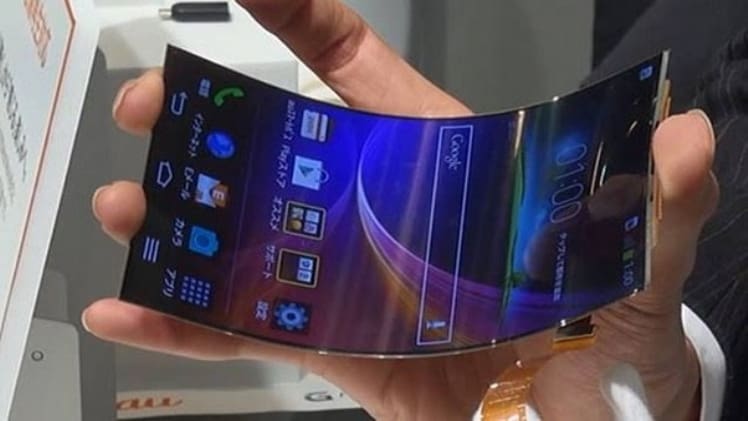
Display panels have been evolving ever since from OLED and AMOLED to POLED and PMOLED and bendable and edge and flexible – it is just impossible to keep track of the newest technology being used in the latest panels, which is going to give the best results. However, LG Display is now all ready to push its plastic OLED (also called POLED) for smartphones, which would surely be compared with another leading display panel manufacturer supplier that is Samsung for their OLED panels. The company is famous for its Super AMOLED technology, which was the backbone of its curved edge design. Though it is tough to understand the main difference between POLED and AMOLED, let us tell you how these two displays are different and what they exactly stand for.
The Beginning With OLED
To understand POLED and AMOLED, we have to go to the origins which is the OLED. All of these panels have millions of OLED – organic light emitting diodes, which means these little things provide light whenever current flows through them. The diodes are thus arranged such that these provide different configurations like red, green, blue, etc. leading to the production of a wide range of colors.
OLED is better than LCD in the way that these can be turn off totally, which leads to better contrast and deeper blacks. We can pass currents by two methods – one is by using a passive wiring matrix, which shall function by flowing current to the whole line of LED one diode at one time, which makes up to be a cheaper option. On the other hand, active wiring matrix has a capacitor as well as thin film transistor network which lets pixels to function separately at the correct voltage. Such matrices are usually contained in the panel made of glass top.
OLED
Almost all high resolution smartphone displays opt for active matrixes as passive matrices work on higher voltages as you get more and more pixels, which basically lowers LED lifetime and it becomes a lot more impractical to use these in high resolution smartphone display panels. Here is what the AMOLED from Samsung works. Though OLED panels *(even ones from LG) also have active matrices but otherwise it is not practical, economical and viable.
Introduction of Plastic Substrates
The first generation of OLEDs had glass substrates, but to introduce better form factors, this layer was then replaced with more suitable and adaptable plastic parts. On one hand, glass is rigid and firm, while on the other, plastic can easily be converted in different shapes. And of course, plastic is more viable, easily available and economical than glass. Many different types and forms of plastics have already been put under trial to test flexibility.
Companies have used PET and PEN (polyethylene terephthalate and polyethylene naphthalate respectively) as well to check the capabilities of plastic. But the point remains that such plastic substrate which will take over the glass one should be able to accommodate the different TFT technologies as well – which means either manufacturing temperatures have to be reduced or plastics that can stand high temperatures have to be used. Thus OLEDs were started to be made using Polyimide Plastics (also called PI) which show better endurance for high temperatures.
Please note that the flexibility of display depends a lot on the substrate used and the TFT temperature at which heating took place. However, TFT can have both a-Si and poly-Si (which is more expensive) used to get flexible displays. Poly-Si is based on LTPS which is better for OLED panels as compared to a-Si given the higher mobility of electrons. This mobility affects the current flowing in the LEDs, which makes these two a lot different in effect. Manufacturing processes used would again affect the performances greatly.
Electron Mobility is nothing but the quantity of current that can flow through the LED parts. On one hand a-Si has low mobility and poly-Si has higher, which will lead to large sizes of transistors needed as well as slow switching on/off times – and would become very problematic to produce extremely high res panels. However, to make a flexy QHD panel, you need a poly-Si no questions asked. In short, manufacturing methods used are extremely important in a display panel’s performance and will differ as we change the manufacturers – even if they have same/similar displays.
What you have to understand though is that Samsung uses its edge AMOLED panels using plastic substrates having poly-Si TFT technology, which is something used in Galaxy S8 as well. On the other hand, we have LG, which will also use POLED technology using plastics (with poly-Si only). Thus both these manufacturers are going down the active matrix with plastic substrate route to make OLED panels with curved displays.
Some Other Differences
What we just said though does not mean that these panels are identical. The quality of TFT and plastic used affect the performance of these displays a lot – and so does the organic materials used. As you might know different LEDs that give off different colors, differ in their brightness levels as well as shelf life, for example the blue light LED would go out the fastest, which requires to use different kind of materials to produce these LEDs using polymers or small molecules so that the design is optimized. Thus different subpixel layouts are required which can then maintain a balance amongst the different parameters including white color point, resolution as well as gamut.
The POLED being produced by LG is supposed to have G Flex 2 featuring a diamond pentile matrix. Coincidentally, it is the same configuration Samsung used for its Galaxy S8 Super AMOLED display – meaning these two panels might demonstrate a lot of similarities.
POLED
Thus POLED is what the name gives out (Plastic substrates), and AMOLED which is something Samsung uses is not limited to plastic substrates – however plastic is what Samsung has been using given the curved design the company puts out for its flagship devices.
